K9CAN
Live MUF / LUF Propagation Maps
MUF (Maximum Usable Frequency) is the highest HF frequency that will refract off the ionosphere and come back down at a given distance; LUF (Lowest Usable Frequency) is the lowest frequency that will still get through before D-layer absorption eats the signal. Work between the two and you're in the usable window. Both maps below pull live data and refresh automatically in your browser.
HF MUF Map
MUF(3000)F2 — global, from live ionosonde data
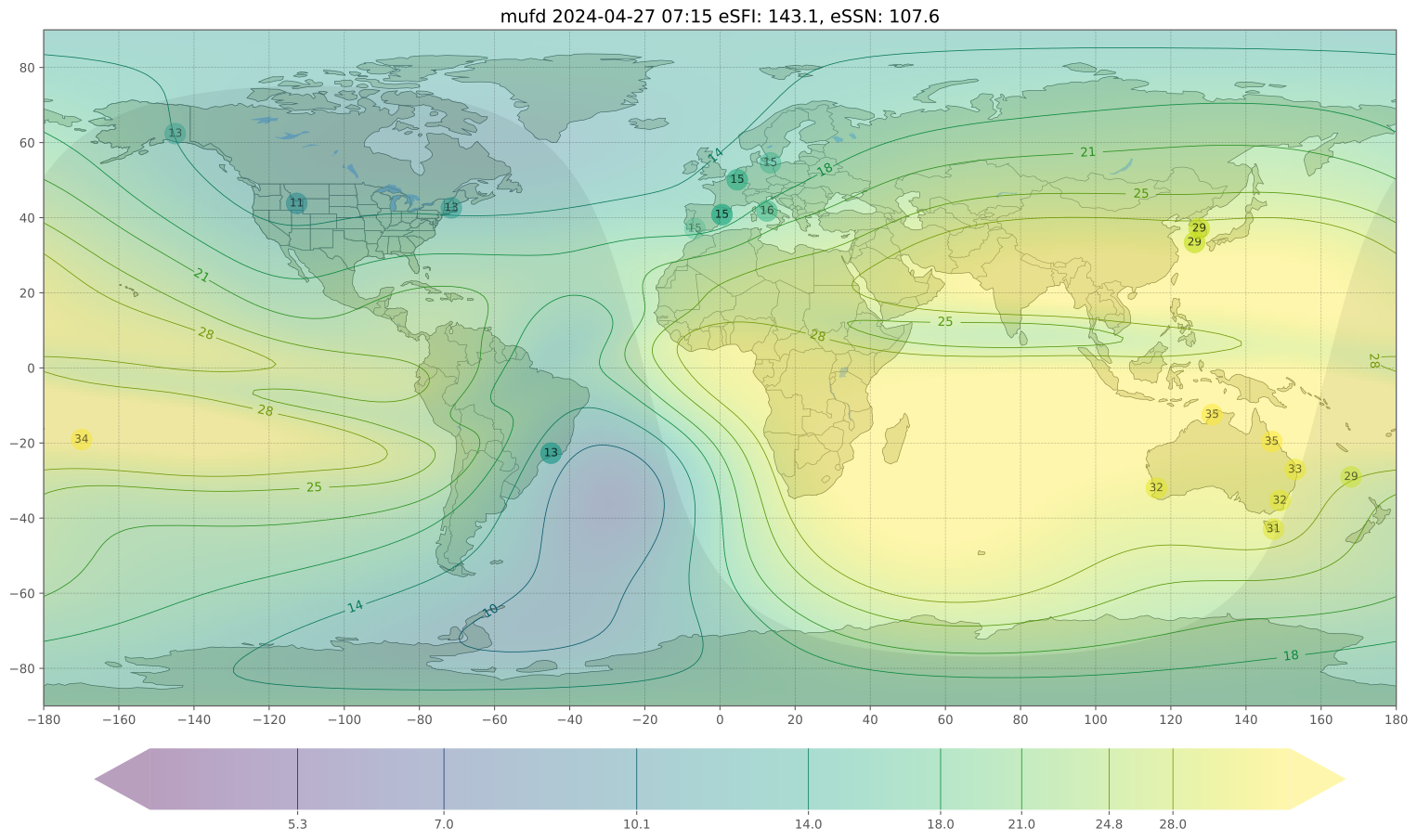
Shows the highest frequency currently supporting 3,000 km F2-layer skip around the globe. Green/blue = lower MUF, red/orange = higher MUF. Updated roughly every 15 minutes from a worldwide network of ionosondes.
Auto-refreshes in-page every 10 minMap: prop.kc2g.com (KC2G, funded by WWROF)
HF LUF Map
D-Region absorption — a live proxy for LUF conditions

There isn't a widely published live "LUF in MHz" world map, but NOAA's D-RAP shows real-time D-layer signal absorption — the same effect that sets the LUF. Heavier absorption (yellow/red, often near the sunlit side and around flares) pushes the LUF higher and can shut out your low bands.
Auto-refreshes in-page every 10 minMap: NOAA / NWS Space Weather Prediction Center (D-RAP)
These are live third-party images hotlinked from their source sites; if either goes down or changes its URL, the image just won't load here. Click either map to open the full interactive version.
HF Band Guide — Best Times & Typical Reach
A quick reference for the ten HF amateur bands: when each one tends to be open, roughly how far it will carry a signal, and what to expect operating on it. Real conditions shift with the solar cycle, season, and time of day — check the solar-terrestrial data above for what's happening right now.
| Band | Best Time | Typical Reach | Details |
|---|---|---|---|
| 160m1.800–2.000 MHz | Night |
|
"Top Band." Groundwave only in daylight (under 100 mi); opens up via skywave at night, best in winter. High atmospheric noise and large antennas needed; DX is rare and prized. |
| 80m / 75m3.500–4.000 MHz | Night |
|
Local NVIS coverage (under 300 mi) by day, expands to regional/continental after sunset. Popular for evening nets and ragchews; noisy during summer thunderstorm season. |
| 60m5.3305–5.4035 MHz | Day & Night |
|
Five channelized frequencies in the US (100 W ERP max). Reliable NVIS band for regional and emergency communications; not for DX. |
| 40m7.000–7.300 MHz | Day & Night |
|
The workhorse band — usable around the clock. Regional contacts by day, DX opens up after dark. Gets crowded with international stations at night. |
| 30m10.100–10.150 MHz | Day & Night |
|
WARC band, CW and digital only (no phone). Less crowded than 40m/20m and a favorite for FT8/PSK and CW DX; transitions well between day and night. |
| 20m14.000–14.350 MHz | Day |
|
"The DX band." Best mid-morning through afternoon; the most reliable worldwide band year-round. Busy and competitive; weaker after dark, especially near solar minimum. |
| 17m18.068–18.168 MHz | Day |
|
WARC band. Quieter than 20m with similar daytime DX potential during moderate-to-high solar activity; a good alternative when 20m is jammed. |
| 15m21.000–21.450 MHz | Day |
|
Best around midday. Excellent worldwide DX near sunspot maximum, with strong openings; can go nearly dead during solar minimum years. |
| 12m24.890–24.990 MHz | Day |
|
WARC band. Behaves like a bridge between 15m and 10m; occasional sporadic-E openings; needs decent solar flux to come alive. |
| 10m28.000–29.700 MHz | Day |
|
Most solar-cycle dependent HF band. Can be "dead" for days near solar minimum, then wide open worldwide with strong signals near solar maximum; summer sporadic-E gives short-skip openings. |
Frequency ranges follow the US amateur band plan. Reach figures are typical/general guidelines, not guarantees — actual propagation varies with solar flux, geomagnetic activity, season, time of day, antenna, and power.